 After using the graphic organizer, students will complete the paragraph frame and then finally rewrite this frame as their published piece. As a motivational tool, teachers decided they would staple an apple to the corner of the completed pieces and reward the students for their efforts.
Thursday, February 28, 2013
Common Core: Main Topic and Key Details
After planning with our first grade teachers for Johnny Appleseed, we decided that we wanted to have our students summarize what they read by identifying the main topic and key details.
I wanted kids to put the events on a numbered timeline, so kids could easily transfer this information onto a paragraph frame using ordinal words as transitions. So, I was sure to number each section where they would write the key details in.
 After using the graphic organizer, students will complete the paragraph frame and then finally rewrite this frame as their published piece. As a motivational tool, teachers decided they would staple an apple to the corner of the completed pieces and reward the students for their efforts.
After using the graphic organizer, students will complete the paragraph frame and then finally rewrite this frame as their published piece. As a motivational tool, teachers decided they would staple an apple to the corner of the completed pieces and reward the students for their efforts.

Sunday, February 24, 2013
Teaching Sentence Variety
Here is a very helpful resource to teach your students about sentence variety, just in time for your writing assessment! Fun and interactive writing sorts help take the guessing out of sentence variety. They give you the "I do" for your lesson and allow you to model effective sentence variety as well as ineffective examples.
We frequently ask our students to vary the types of sentences they use in their essays, or ask them to revise the types they have already written, but do not have a visual way of showing them what we mean. The sentence variety writing sorts come with 7 paragraphs with low, medium, and high sentence variations.
 A graphic organizer is also provides to assist with scaffolding. This graphic organizer focuses on 4 main areas of sentence variation: punctuation, transitional phrases, sentence length, and conjunctions. Help your students identify various types of sentence structures. In addition, I've included the answer key for each paragraph; you may choose to use this resource in a center or with your writing interventionist.
 And finally, the attractive sort sheet makes this engaging learning activity seem more like a game. We used these sorts as the beginning of our writing instruction. Kids literally ran to class saying they couldn't wait to play "the game." I hope you enjoy it as much as we did.
Take a look at my TPT store to download your copy. http://www.teacherspayteachers.com/Product/Writing-Sentence-Variety-Writing-Sorts
And finally, the attractive sort sheet makes this engaging learning activity seem more like a game. We used these sorts as the beginning of our writing instruction. Kids literally ran to class saying they couldn't wait to play "the game." I hope you enjoy it as much as we did.
Take a look at my TPT store to download your copy. http://www.teacherspayteachers.com/Product/Writing-Sentence-Variety-Writing-Sorts
 A graphic organizer is also provides to assist with scaffolding. This graphic organizer focuses on 4 main areas of sentence variation: punctuation, transitional phrases, sentence length, and conjunctions. Help your students identify various types of sentence structures. In addition, I've included the answer key for each paragraph; you may choose to use this resource in a center or with your writing interventionist.
 And finally, the attractive sort sheet makes this engaging learning activity seem more like a game. We used these sorts as the beginning of our writing instruction. Kids literally ran to class saying they couldn't wait to play "the game." I hope you enjoy it as much as we did.
Take a look at my TPT store to download your copy. http://www.teacherspayteachers.com/Product/Writing-Sentence-Variety-Writing-Sorts
And finally, the attractive sort sheet makes this engaging learning activity seem more like a game. We used these sorts as the beginning of our writing instruction. Kids literally ran to class saying they couldn't wait to play "the game." I hope you enjoy it as much as we did.
Take a look at my TPT store to download your copy. http://www.teacherspayteachers.com/Product/Writing-Sentence-Variety-Writing-Sorts
Wednesday, February 20, 2013
Getting Started with Personal Opinion Essays
This resource addresses Common Core: CCSS.ELA-Literacy.W.4.1c Link opinion and reasons using words and phrases (e.g., for instance, in order to, in addition).
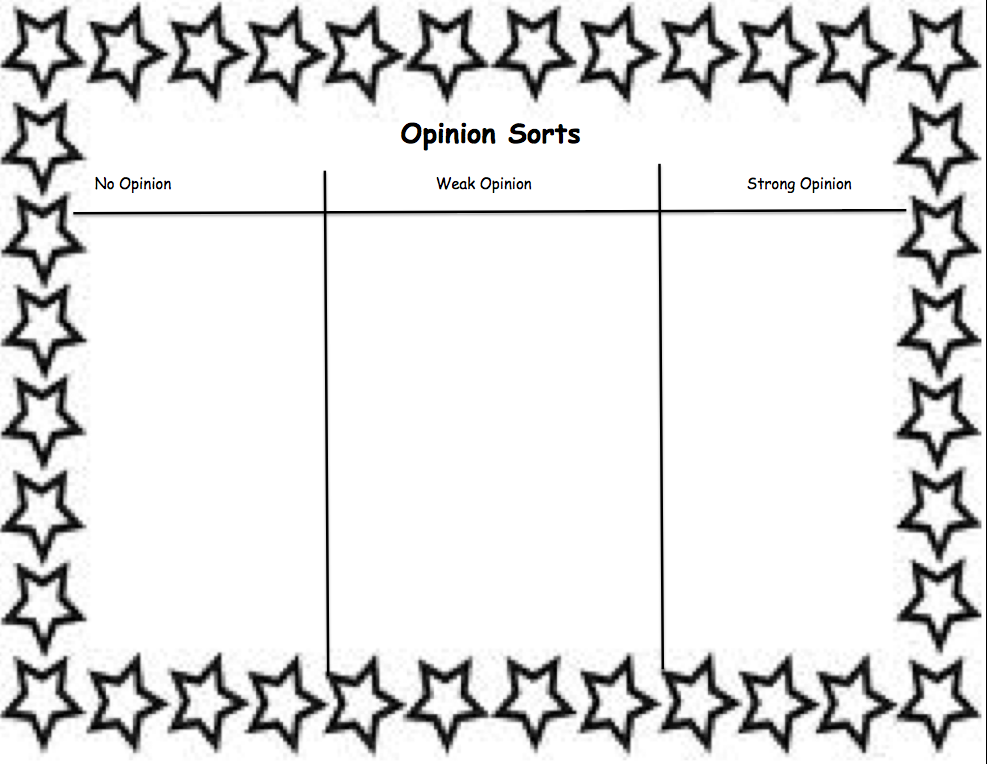
 Common Core asks our students to have an opinion, know how to state it, and give the reasons why a child is for against a certain topic. This resource contains an easy game (P.O.G.) to use for introducing personal opinion and a sort that helps your students understand the difference between no opinion, a weak opinion, and a strong opinion. I don't know about your kids, but ours LOVE games. We played P.O.G. today and kids had a great time collaborating with each other to try to make the strongest argument based on the topics on the cards. It was fun and really easy to play.


 In addition, it gives a list of personal opinion transitional devices, possible prompts, and mentor texts to use when modeling.
 We had a lot of fun with this mini-lesson, but best of all, our students were able to demonstrate their understanding in their own essays. Bring on the writing assessment!
You can find the entire mini-lesson on my TPT store: http://www.teacherspayteachers.com/Product/Writing-Getting-Started-with-Personal-Opinion-Essays
We had a lot of fun with this mini-lesson, but best of all, our students were able to demonstrate their understanding in their own essays. Bring on the writing assessment!
You can find the entire mini-lesson on my TPT store: http://www.teacherspayteachers.com/Product/Writing-Getting-Started-with-Personal-Opinion-Essays
 Common Core asks our students to have an opinion, know how to state it, and give the reasons why a child is for against a certain topic. This resource contains an easy game (P.O.G.) to use for introducing personal opinion and a sort that helps your students understand the difference between no opinion, a weak opinion, and a strong opinion. I don't know about your kids, but ours LOVE games. We played P.O.G. today and kids had a great time collaborating with each other to try to make the strongest argument based on the topics on the cards. It was fun and really easy to play.


 In addition, it gives a list of personal opinion transitional devices, possible prompts, and mentor texts to use when modeling.
 We had a lot of fun with this mini-lesson, but best of all, our students were able to demonstrate their understanding in their own essays. Bring on the writing assessment!
You can find the entire mini-lesson on my TPT store: http://www.teacherspayteachers.com/Product/Writing-Getting-Started-with-Personal-Opinion-Essays
We had a lot of fun with this mini-lesson, but best of all, our students were able to demonstrate their understanding in their own essays. Bring on the writing assessment!
You can find the entire mini-lesson on my TPT store: http://www.teacherspayteachers.com/Product/Writing-Getting-Started-with-Personal-Opinion-Essays
Monday, February 18, 2013
Identifying the Topic and Main Idea in Text
Last week, I experienced one of the best common planning sessions with our 2nd grade teachers. I loved that we were able to thoroughly dissect one of our common core standards. The standard is: Common Core State Standard: RI.2.2-Identify the main topic of a multi-paragraph text as well as the focus of specific paragraphs within the text.
We wanted to understand each part of this standard. In the past, we have taught main idea and understanding the topic of a text, but never together in this way. We wanted to make sure our students internalized the importance of putting the two together.
 I created a graphic organizer for our students to use throughout the week. This graphic organizer will be pasted into their interactive journals. The graphic organizer can be used with any text.

 By the end of the book, students will be able to write a summary of what the topic is and add the 3 most important things they learned about this topic. I'm very excited to see the end results.

 I created a graphic organizer for our students to use throughout the week. This graphic organizer will be pasted into their interactive journals. The graphic organizer can be used with any text.

 By the end of the book, students will be able to write a summary of what the topic is and add the 3 most important things they learned about this topic. I'm very excited to see the end results.

Tuesday, February 12, 2013
My First Freebie


Monday, February 11, 2013
Identifying Main Idea in Nonfiction
I just updated a resource that helps you teach your students how to identify the main idea using text features.
 Then, it guides them into asking questions about their main idea statement and using these questions to identify the relevant details. The resource provides a basic nonfiction paragraph about Rosa Parks. The teacher uses the gradual release model to walk students through the entire process.

 Finally, it teaches them how to combine all of these components and write their own summarizing paragraph.
 I have also provided detailed notes to help you in your teaching. You choose whether to use the included script or not. The 29-slide powerpoint incorporate the gradual release model and cooperative learning to make this one engaging product. The components of the gradual release model are indicated on the slides. You may use this resource with any nonfiction text.
You may purchase the PowerPoint on my TPT site:
I have also provided detailed notes to help you in your teaching. You choose whether to use the included script or not. The 29-slide powerpoint incorporate the gradual release model and cooperative learning to make this one engaging product. The components of the gradual release model are indicated on the slides. You may use this resource with any nonfiction text.
You may purchase the PowerPoint on my TPT site:


Friday, February 8, 2013
The Magnify THIS Challenge!
For the last two days, our kids have been reviewing the magnified moment process. To make it a little more exciting, I created the "Magnify THIS!" Challenge.
 Students used the gradual release model to identify a sentence from a paragraph that would make for a great magnified moment. They used the elements of a magnified moment (sensory details, onomatopoeia, amazing adjectives, and vivid verbs) to zoom in and expand on one moment in time.

 They had 10 minutes to write their paragraph. After, kids used a collaborative strategy I came up with called, "Sharing Go 'Round" to share their paragraphs with each person in the group. The group had to decide which paragraph was the best representation of a magnified moment. That student would then represent their group in the Challenge. The writing teacher and I served as the voting panel. The kids loved it! Here are some pictures of our kids in action.


 The entire lesson can be found on my TPT page. http://www.teacherspayteachers.com/Product/Writing-Magnify-THIS-Challenge


Subscribe to:
Posts (Atom)